What should directories look like?

¶ 1 Leave a comment on paragraph 1 0 Some things to consider:
- ¶ 2 Leave a comment on paragraph 2 0
- What are the different models for tool directories?
- Do we need standardized ontologies?
- How can we involve volunteers?
- Why shouldn’t we just let Google do it?
Quinn Dombrowski
¶ 3 Leave a comment on paragraph 3 0 Two different models come to mind for tool directories: broad ones that attempt to be comprehensive on the scale of something like “digital humanities”, and more focused ones that are centered on tools for a particular method (GIS tools) and/or kind of data (tools for doing NLP tasks on Russian).
¶ 4 Leave a comment on paragraph 4 0 The latter, in particular, suffers from findability challenges; conceivably, one could compile a directory of directories, but I’m wary of going that meta when sustainability and upkeep are challenges for any directory.
¶ 5 Leave a comment on paragraph 5 0 It may be easier to get people to contribute to more focused directories — or at least, it’s more manageable to maintain them through infrequent upkeep, because you’re not trying to keep tabs on everything.
¶ 6 Leave a comment on paragraph 6 0 The broader directory type is appealing, especially for people new to the field who aren’t sure what method(s) they might want to use, to have a single place to look. Updating it, though, does mean keeping tabs on everything. Big directories (like DiRT) have tried to have the best of both worlds by assigning “editors” to specific “sections”, but it’s hard to maintain volunteer engagement.
¶ 7 Leave a comment on paragraph 7 0 Which brings me to the question of volunteers. Maybe a volunteer-run specific directory can work if the scope is limited, and people are comfortable with infrequent updates. But I’m convinced that a large directory has to pay people to do the maintenance work, otherwise it won’t happen. All the good intentions in the world aren’t enough to overcome the fact that people have a lot of things to do, and it’s easy (and necessary) to deprioritize tedious volunteer tasks like directory updates until the work piles up to the point where it’s a source of guilt that will never go away.
¶ 8 Leave a comment on paragraph 8 0 Honestly, I’m not entirely convinced that we shouldn’t “let Google do it”. Not literally in the sense of “let the advice to new scholars be that they should just Google for tools”, but if we’re able to normalize tool reviews as a meaningful, recognized (and, dare I dream, cited) form of scholarly writing, and if we’re able to make progress on getting people to cite tools in their papers, perhaps pointing new scholars to existing literature as a channel for finding out about tools (in their context of use, which is even better than a listing in a directory) could be a better approach.
LISA SPIRO
¶ 9 Leave a comment on paragraph 9 0 Attracting volunteers and keeping them motivated pose significant challenges. In my experience as both an editor and volunteer myself, volunteers’ intentions are good, but understandably other priorities draw their attention. People should draw tangible benefits from their contributions, such as recognition, belonging to a robust community, the opportunity to learn, satisfaction in contributing to something meaningful, and validation of their identity.
¶ 10 Leave a comment on paragraph 10 0 While many crowdsourcing efforts have failed, several social cataloging and citizen science websites have made it, including Goodreads (which Amazon owns, so…), eBird, and Board Game Geek. I suspect that these websites have succeeded because they tap into participants’ passion. Further, eBird works because it enables birders to log their sightings and compare them with others, reflecting what the birding community values; it also recognizes the most engaged participants through public rankings. Of course, these websites serve large communities and enjoy paid staffs. Perhaps the digital humanities community isn’t big enough to sustain a tool review resource, and I don’t think one’s identity is tied to software reviews in the same way as it is to books, birding and games. Still, I wonder if we might learn something from these models.
¶ 11 Leave a comment on paragraph 11 0 In any case, I think we need something more robust than Google. If we just Google for tools, we waste time sorting through irrelevant results and miss relevant items. Further, we wouldn’t be able to learn about these tools at a glance and quickly identify similar tools.
Laure Barbot / Frank Fischer
¶ 12 Leave a comment on paragraph 12 0 Let us understand the question, »What should directories look like?«, literally. ? Here are some mock-ups of the future Marketplace, done by our UX designer Justyna Wytrążek:
¶ 13
Leave a comment on paragraph 13 0
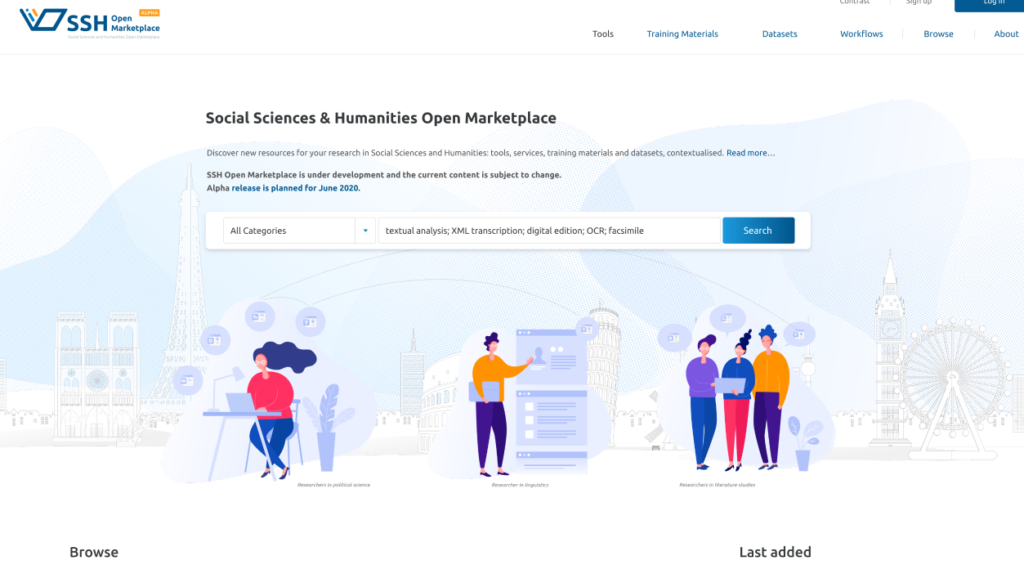 SSH Open Marketplace (Homepage)
¶ 14
Leave a comment on paragraph 14 0
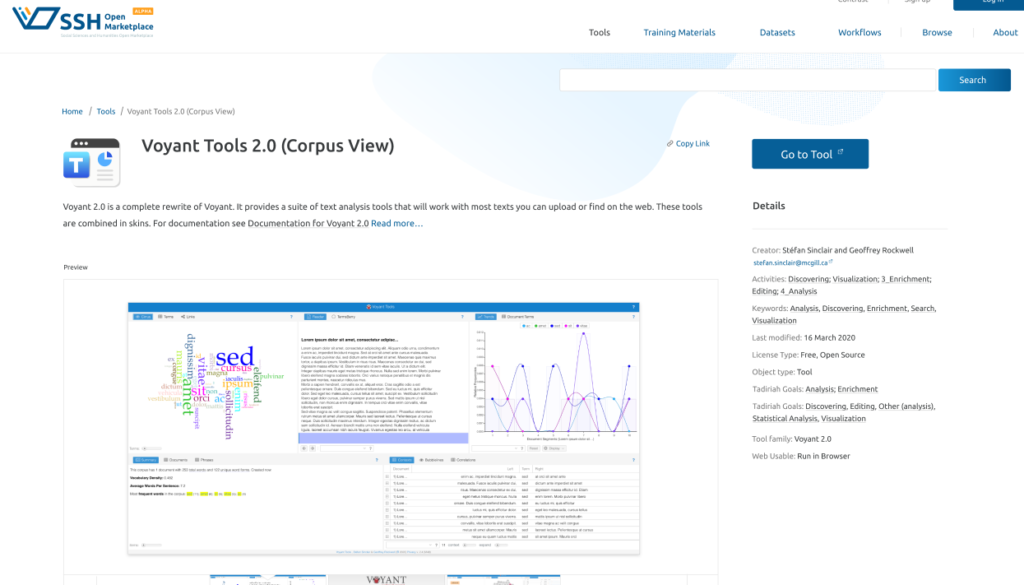 The future SSH Open Marketplace (Tool View)
Comments
Comments are closed
0 Comments on the whole Page
0 Comments on paragraph 1
0 Comments on paragraph 2
0 Comments on paragraph 3
0 Comments on paragraph 4
0 Comments on paragraph 5
0 Comments on paragraph 6
0 Comments on paragraph 7
0 Comments on paragraph 8
0 Comments on paragraph 9
0 Comments on paragraph 10
0 Comments on paragraph 11
0 Comments on paragraph 12
0 Comments on paragraph 13
0 Comments on paragraph 14